How Much Does a Bookkeeping Cleanup Cost?
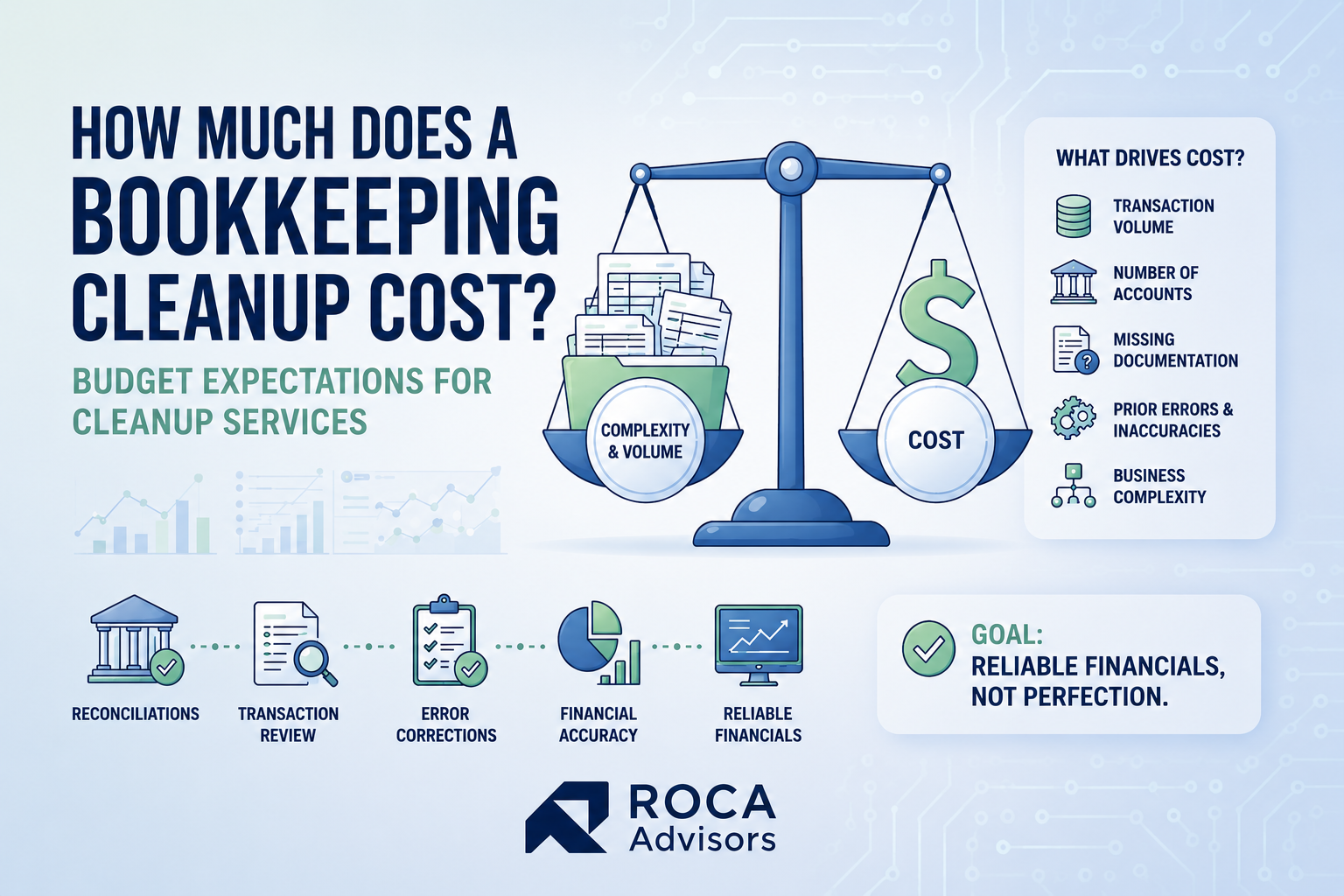


Many business owners are surprised when they receive a quote for bookkeeping cleanup work.
A common assumption is that cleanup pricing is simply based on how many months or years the books are behind. In reality, the condition of the records often matters far more than the time period itself.
In some situations, a three-month cleanup can be more complicated than cleaning up an entire year of bookkeeping.
Throughout my experience working with businesses as a Fractional CFO, I have seen cleanup projects range from relatively straightforward corrections to full financial reconstructions requiring significant research and analysis.
This is one reason bookkeeping cleanup projects can sometimes cost more than the normal bookkeeping for the same period.
The goal of a cleanup project is not perfection. The goal is creating reliable financial records that business owners can actually trust and use moving forward.
A bookkeeping cleanup is the process of reviewing, correcting, organizing, and reconciling historical financial records.
Depending on the condition of the books, cleanup work may include:
Some projects only require minor corrections, while others involve rebuilding significant portions of the accounting records.
At ROCA Advisors financial cleanup services, cleanup projects are typically approached by first understanding the condition of the books, the goals of the business owner, and the level of accuracy required moving forward.
The complexity of the project is usually the biggest factor affecting cost.
Some of the most common variables include:
Transaction volume
A business with hundreds or thousands of monthly transactions will naturally require more review and reconciliation work than a business with minimal activity.
Number of accounts
Multiple bank accounts, credit cards, loans, and payment platforms increase the amount of reconciliation and analysis required.
Mixed personal and business activity
One of the most common issues in small businesses is personal spending flowing through business accounts. Separating those transactions later can significantly increase cleanup time.
Missing documentation
Cleanup projects become more difficult when bank statements, receipts, payroll reports, or prior tax records are incomplete.
Prior bookkeeping errors
Incorrect reconciliations, duplicate transactions, miscategorized entries, and balance sheet inaccuracies can create problems that compound over time.
Inventory, multi-entity, or multi-currency complexity
Businesses with inventory tracking, multiple entities, foreign currencies, or more advanced accounting requirements often require additional review and adjustments.
Tax filing considerations
In some situations, cleanup work may need to align with prior tax filings or prepare the books for upcoming tax returns.
And of course, there can be many other variables depending on the nature of the business.
This is why cleanup pricing is usually based on complexity and workload rather than simply counting how many months are behind.
Many business owners compare cleanup pricing to their normal monthly bookkeeping cost and wonder why the cleanup project is significantly more expensive.
The reason is that cleanup work is often far more investigative in nature.
With ongoing bookkeeping, transactions are typically reviewed and reconciled in real time while supporting information is still available and the activity is fresh.
Cleanup projects are different.
By the time cleanup work begins:
Instead of simply recording activity, cleanup work often involves researching what happened and determining how accounts should actually tie together.
This is also why cleanup projects can sometimes become more complicated than starting with a fresh set of books.
The objective is not creating “perfect” records down to every historical detail. In many cases, the goal is building reliable financials that support tax filings, business decisions, and ongoing bookkeeping moving forward.
Not all cleanup projects involve the same level of work.
Some businesses may only need minor corrections, while others require more extensive reconstruction of historical records.
Common types of cleanup projects include:
Catch-up bookkeeping
Recording historical transactions and bringing the books current after periods of inactivity.
Tax-ready cleanup
Organizing and correcting financial records so they can support tax preparation and filing requirements.
Full reconciliation cleanup
Reviewing and reconciling bank accounts, credit cards, loans, and balance sheet accounts to improve accuracy.
Historical reconstruction
More extensive projects involving missing information, incomplete records, or significant prior bookkeeping issues.
Partial cleanup projects
In some situations, it may not make sense to rebuild every historical period.
For example, a business may choose to:
This can sometimes be a more practical and cost-effective approach than attempting to reconstruct many years of activity.
The right scope usually depends on the goals of the business and the condition of the records.
Bookkeeping cleanup costs can vary significantly depending on the complexity of the project.
Some smaller cleanup projects may be relatively manageable, while larger multi-year projects involving multiple accounts, missing information, or significant prior errors can become much more involved.
One important thing to understand is that the cheapest option is not always the least expensive in the long run.
Poor cleanup work can create:
In many cases, reliable financial records are far more valuable than simply completing the cleanup as cheaply as possible.
For business owners, the most important step is usually understanding the condition of the books and clearly defining the objective of the cleanup project before work begins.
A bookkeeping cleanup should ideally solve two problems:
One of the most common situations I see is businesses investing significant time and money into cleanup work, only to fall behind again a few months later because ongoing processes were never improved.
Reliable monthly bookkeeping is usually far less stressful and less expensive than repeating major cleanup projects every few years.
Some practical ways to reduce future cleanup work include:
Ongoing bookkeeping also creates better visibility into cash flow, profitability, and business performance throughout the year instead of waiting until tax season.
Businesses looking to maintain cleaner financial records moving forward can learn more about bookkeeping services offered by ROCA Advisors.
And for business owners unsure where to begin, it can often help to schedule a consultation before deciding on the scope of the cleanup project.
Messy bookkeeping is far more common than many business owners realize.
In many cases, businesses fall behind because owners are focused on operations, sales, growth, or simply trying to keep up with day-to-day responsibilities. Over time, small bookkeeping issues accumulate until the financial records become difficult to trust.
The important thing is addressing the problem before it creates larger issues involving taxes, cash flow visibility, financing, or decision-making.
A bookkeeping cleanup is not about creating perfect historical records. The goal is creating reliable financial information that supports the business moving forward.
In my experience, business owners often feel significant relief once the books are organized and they can finally understand the financial position of the company with more confidence.
At ROCA Advisors, cleanup projects are approached with the objective of creating clarity, improving reliability, and helping businesses establish stronger ongoing financial processes.
It depends on the complexity of the records and your familiarity with accounting systems.
Smaller cleanup projects with organized records may be manageable for some business owners. However, projects involving multiple accounts, missing documentation, unreconciled balances, inventory, or prior bookkeeping errors can become significantly more complicated.
One risk with DIY cleanup work is unintentionally creating additional issues that may require further corrections later.
There is no universal timeline.
Some cleanup projects may take a few days, while others can take weeks or months depending on factors such as:
In many cases, gathering documents and clarifying historical activity can take as much time as the bookkeeping work itself.
Not necessarily.
In some situations, rebuilding every historical period may not be practical or cost-effective.
For example, some businesses may choose to:
The right approach depends on the goals of the business and the condition of the records.
Yes.
Incorrect or incomplete bookkeeping can create issues such as:
This is one reason cleanup work often focuses on creating reliable financial records rather than simply categorizing transactions quickly.
The most effective approach is maintaining consistent bookkeeping throughout the year.
This usually includes:
In many cases, ongoing bookkeeping support is significantly easier and less expensive than repeating large cleanup projects later.